
You know the feeling. You load a pack for a two-night trip, you strap it on, and you think you have it sorted. Then the trail does what trails do. The hip belt migrates up across your ribs, the shoulder straps dig in where your collar meets your neck, and by mile four you are leaning forward like you are hauling a cooler that will not stay put. If you have owned a budget pack, you have owned that feeling, and the Loowoko 50L is exactly the kind of pack that people buy hoping the feeling will not come. I am writing this because the Loowoko does some things genuinely well and other things that the photos will never tell you about.
I want to be plain about my bias up front. I did not buy this pack expecting it to replace a specialty mountain rig that costs a small fortune, and I think anyone who does is setting themselves up for disappointment. I bought it as a working weekend pack for northwest Washington, where the weather is damp, the trails are rocky, and the load stays modest if you pack with a little discipline. That is the fair test for a pack in this range, and the Loowoko passed some parts of it cleanly and stumbled on others. This is the honest side of that pack. The good and the annoying. The corners it cuts, named one at a time.
The Quick Verdict
A genuinely good value for light and medium loads under about 28 pounds. Past that, and in sustained rain, the corner-cutting shows up in ways a backpacker should plan for.
Amazon Check Today's Price →If you are a weekend packer starting out, this is one of the few packs in its price range actually worth carrying
The Loowoko 50L is not a specialty ultralight pack. It is a solid, honest, entry-level volume pack that will get most weekenders out the door with a full kit for very little money. If that is your situation, here is today's price before we get into the hard parts.
Amazon Check Today's Price on Amazon →How I've Used It
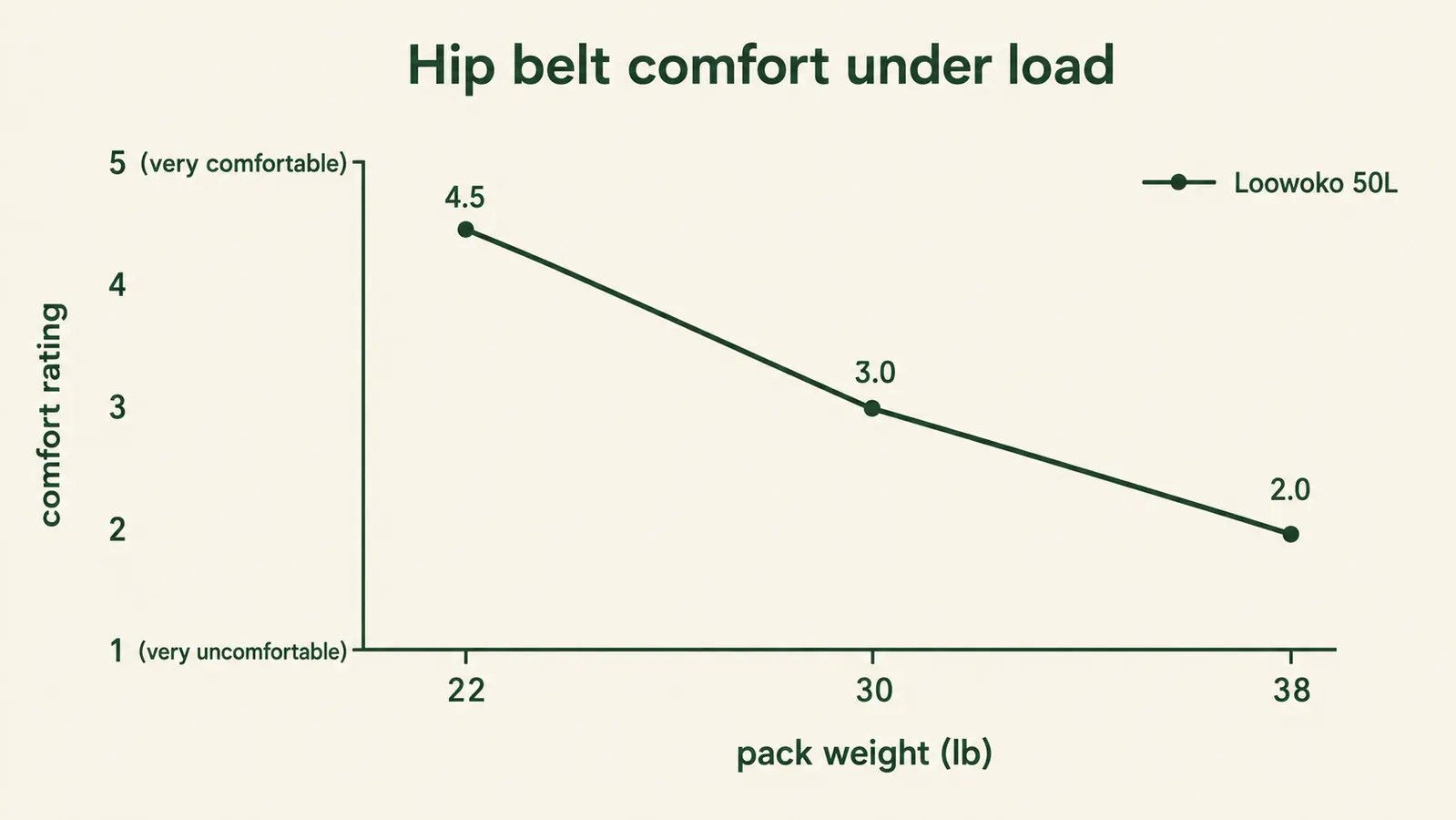
To be clear about what this review is and what it is not, this is not a pack I threw at a single 10-mile glamour hike and then wrote a paragraph about. I ran it through a season of the kind of trips I actually take in northwest Washington. A 6-mile overnighter up a damp forested drainage where the switchbacks turned to mud by the second mile. A 9-mile loop above treeline where half the trail was loose scree and the other half was talus you had to pick a line through. A weekend on the coast where we humped everything in over wet sand and the pack spent the night under a tarp beside a not-fully-dry fire ring. Total, about eleven nights with the Loowoko, with loaded weights from a light 22 pounds up to a heavy 38 when I convinced myself I needed all the cooking gear I definitely did not need.
I mention the weight spread because it is exactly where this pack decides who it is for. Under about 26 to 28 pounds, the Loowoko feels composed and a little impressive for the money. The belt sits where it should, the straps stay put, and the pack moves with you rather than fighting you. Over that line, the limits start talking and you can feel each one of them in turn. That split is the whole story of this review, so let me stop summarizing it and break down each piece of the pack so you can decide for yourself whether the trade-offs are ones you can live with.
The Frame and the Load: Where the Light Build Shows
The single most important thing a backpacker should know about the Loowoko 50L is that its frame is light and its harness is not carrying the load the way a more expensive pack does. It has an internal frame, yes, and the back panel is ventilated, which sounds great on paper and reads even better in the marketing copy. In practice the metal stays press the padding pretty thin, and the padding itself is firm and on the short side. That means the weight rides lower and heavier on your hips than the listing lets on, and it rewards you for keeping the total load honest. This is not a pack that will pretend a heavy week is a light day.
On the coast trip I loaded it to 34 pounds. Two days of shells, water, a camp chair I swore I would not bring and I brought anyway, and a first aid kit that takes up a third of a side pocket on its own. By the afternoon the shoulder straps had a real bite in them and the hip belt, which is genuinely comfortable enough at 24 pounds, had squashed down under the load and started to dig at my hip bones. That is not a catastrophic failure, and I do not want to sound like the pack fell apart. It did not. But it is the exact thing a heavier pack with a proper load-lifter system does not do, and it is the difference between a day that ends comfortably and a day that ends with you counting trailhead miles.
The frame also flexes side to side more than I would like whenever the pack is loaded full and I lean over on a scramble. Not enough to worry about the pack breaking, it is sturdy and the stitching held, but enough that you feel the bag sway a little when you are off-balance and catching yourself on a rock. For trail hiking at a normal pace you will barely notice it, and for most weekenders that is all you will ask of it. But for anything off-trail, or over sustained rocky descents where your torso moves a lot with each step, the flex is the first thing you will feel, and it is the thing that quietly reminds you this is a value pack and not a precision tool.
The Rain Cover: The Most Honest Thing on the Listing, and the Biggest Letdown
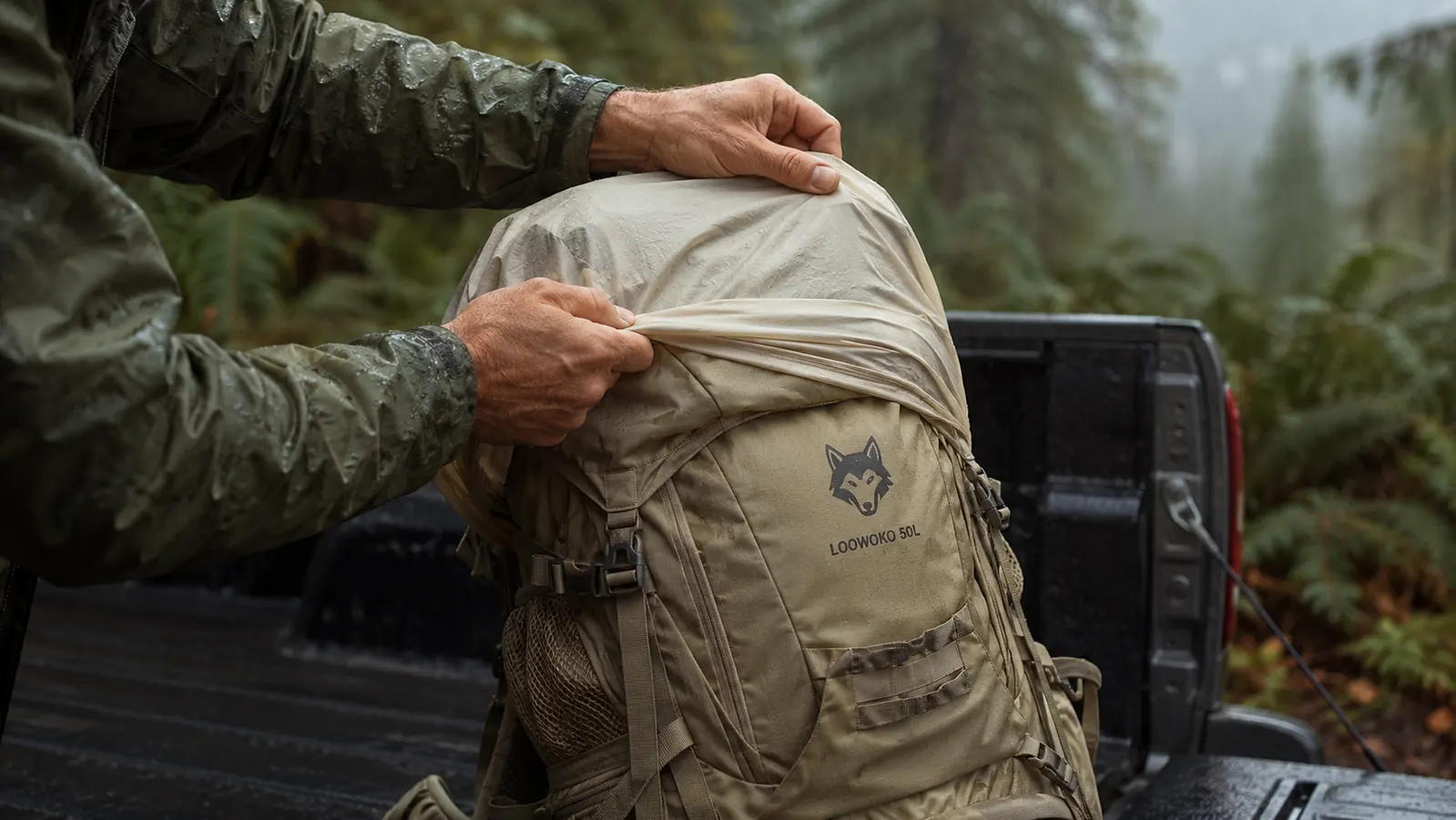
Here is what nobody tells you about the Loowoko's included rain cover. It is real, it is white, and it does cover the pack in a light sprinkle. That is where the good news ends. The elastic around the edge is loose enough that a stiff coastal breeze will balloon it out like a sail, and on the two-day rain trip the cover slipped up off the bottom corner within a few miles of setting out. That left the lower half of the pack, where your sleeping bag sits in its own compartment, open to the weather. Real rain found my bag stuff sack, and my down puffy came out damp. Not soaked, nothing was ruined, but damp enough that I noticed the difference the next morning and had to think about how to manage it for the rest of the trip.
The fix everyone lands on, myself included, is a heavier aftermarket rain cover with a proper drawcord, which costs a small amount on its own and packs down small in a side pocket. Once you add that, the wet-weather problem mostly goes away and you can trust the pack in a genuine soak. But the whole point of buying a budget pack is not having to immediately buy a second rain cover to make the first one work. So call this a real asterisk on the value. Budget for the upgrade or accept that the stock cover is fine only in light or brief rain, and plan your trip accordingly. That is a frustration, not a dealbreaker, but it is exactly the kind of corner you deserve to know about before you buy.
It rained hard for two days straight on the coast trip. My down puffy came out of that pack damp because the included rain cover slipped off the bottom corner by mile four.
Zippers, Pockets, and the Organizer That Mostly Works
The zippers are the place the corner-cutting is most visible, and it is a fair trade, so let me give it a balanced look rather than just listing complaints. The main compartment is a top-loader with a drawstring and a flap, which is the classic backpacking setup and it is practically bombproof; I never once worried about the top failing. The zippered extras, the front shovel pocket and the two side access zippers, use hardware that feels a little thin to the hand. In two seasons none of them broke, and they all still pull smoothly, so this is not a durability scare. But they do not have the reassuring chunk of a pack costing several times more, and I would not hang my entire load off one of these zippers, nor would I trust a side pocket under a fully stretched load with something heavy in it.
The layout itself is genuinely good for the money, and this is where the Loowoko earns a lot of its goodwill. There is a padded sleeve at the back that most people use for a hydration bladder, which keeps the weight close to your spine where it belongs. The front pocket swallows a light jacket or a set of extra gloves without an argument. The bottom sleeping-bag compartment has its own access zipper, which is a real convenience you usually do not get at this price and it makes loading and unloading much less of a fishing expedition. The side mesh pockets hold a standard Nalgene without drama, and the trekking pole loops work as advertised. For how you actually pack a weekend, the organization is the strongest part of this pack, and I would not change much about it.
Comfort and Fit: Size Up Before You Believe the Photos
Fit is the second most personal thing about any pack, right after load weight, and I want to be fair about the Loowoko here because fit complaints can read as an attack when they are really just geometry. I am average sized, around 5 foot 10 on a good day, and the torso on this pack runs just a touch short. It fit me fine once I adjusted the straps, and I was comfortable with a light weekend load. But someone with a longer torso, say 6 foot 2 or up, is going to find the shoulder straps sitting higher than they want and the hip belt riding up across the waist rather than sitting on the hip bones where it belongs. If you are on the tall side, read the size chart carefully and probably size up, or expect to be adjusting the straps all day. A badly fitting hip belt is the single fastest way to end up hating a pack no matter what it cost.
For someone in the medium-torso range at a reasonable weekend load, the comfort is honestly fine, sometimes better than fine, and I do not want the critique above to drown that out. The padding on the hip belt is firm rather than plush, but the belt grips the hips well and does not slide around once it is cinched. The load lifters, the little straps at the top of the shoulder harness, do actually pull some weight off your shoulders once you learn to dial them in, which is more than some packs at twice the price manage. It is not a boutique fit with molded foam and a custom torso range. It is a real, working fit, and at this price that is the pleasant part of the review that I would want any reader to hear.
What I Liked
- Real 50 liter volume with a dedicated sleeping-bag compartment and front shovel pocket
- Genuinely comfortable under about 28 pounds at a price that is hard to beat
- Ventilated back panel, hydration sleeve, trekking pole loops, and an included rain cover
- The load lifter straps actually help once you dial them in
Where It Falls Short
- Included rain cover slips and balloons in real wind and steady rain, leaving the pack exposed
- Frame and harness flex under heavier loads, so it sways on scrambles and digs past 30 pounds
- Zippers feel thin compared to pricier packs, fine for medium loads but not confidence-inspiring at max
- Torso runs short, so taller backpackers need to size up or shop elsewhere

Who This Is For
The Loowoko 50L is for the weekend backpacker who is new enough to this hobby that they do not want to spend a small fortune before they know what they actually like, and who keeps their trips light and quick. If you are carrying maybe 22 to 27 pounds, which is a very achievable weekend load if you leave the extra layers and the luxury items at home, this pack is a legitimate, comfortable, well-organized choice that will not embarrass you on the trail. It is also a fine spare pack for the truck, or a smart loaner for a friend who is trying backpacking for the first time and should not buy a specialized pack before they know the hobby fits them. If you are in that camp, the Loowoko makes sense as a first real pack.
It is also a reasonable pick for the person who knows they will only go out a handful of weekends a year and does not need their gear to be the last word in engineering. A pack you actually take is worth more than a perfect pack you felt too expensive to bring. If that is your relationship with the hobby, the Loowoko offers the volume, the organization, and the comfort at light loads that will cover most of what you will ever ask of it, and the price leaves room in the budget for everything else you still need to buy for your first few trips.
Who Should Skip It
Skip the Loowoko if your trips run heavy, which for a backpacker usually means cold-weather camping, a full bear canister, camera gear, or more than one person's worth of shared tent weight. If you are regularly loading past 30 pounds, the frame flex and the hip belt bite will make you miserable by day two, and you are genuinely better served by a pack with a stiffer belt and a heavier frame even if it costs more. Also skip it if you spend most of your trips in sustained coastal or alpine rain without adding your own heavier rain cover, because the stock cover will not carry the job in a real soak. And skip it outright if you have a long torso, because this pack will not fit you comfortably no matter how good the value is.
And be honest about your own shoulder season ambitions before you buy. If you know the bulk of your trips happen in October and April, when the trail is wet and the lowland nights hover near freezing, the thicker you layer, the heavier the pack gets, and heavy is exactly where this pack runs out of road. A heavier pack carries a heavier winter load with less complaint. This is not to talk you out of the Loowoko entirely, it is to point out that it is a fair-weather, lighter-load tool, and matching the tool to the trips you actually take is the whole game when you are spending your own money.
Know your load, know what you are buying, and this pack is worth every last dollar it costs
Keep it under 28 pounds, budget for a cheap aftermarket rain cover upgrade, and the Loowoko 50L is a genuinely honest weekend pack that will not embarrass you on the trail. That is a fair deal at the price. Here is today's price if you want to see where it lands.
Amazon Check Today's Price on Amazon →