

Almost every review of the Marmot Precip Eco opens with the waterproof rating and closes with the word value. I am going to start where the marketing stops, which is the first warm, rainy climb where you find out what breathable actually means. I bought the Precip Eco on the strength of that word. Two Puget Sound winters later I have a much sharper picture of what it does well, what it flat-out will not do, and the handful of things I genuinely wish someone had told me before I handed over the money.
So let me say the honest part up front. This is a good jacket and I still reach for it most wet days. But an honest review only counts if it includes the parts that are true and unflattering. Here is the unvarnished side of the Marmot, the fit caveats, the breathability ceiling, the DWR that needs your help to stay alive, the hood that wants a second look, and the people who should absolutely buy something else. If you are weighing the Precip Eco against cheaper shells or wondering whether the next tier up is really worth it, this is the version I would want to read before I swiped my card.
The Quick Verdict
A genuinely good all-round PNW hardshell once you know its limits, but breathable is marketing shorthand you will spend the first climb reinterpreting.
Amazon Check Today's Price →Read this before you pick a size, then see what is on the shelf today.
The Precip Eco is worth owning for the right kind of Pacific Northwest wet. This review covers the caveats so you buy the right one first. Check today's price on Amazon for the current colors and sizes.
Amazon Check Today's Price on Amazon →The Breathability Truth Nobody Files Under Marketing
Here is the thing I wish had been on the box: breathable is a relative word. The Marmot Precip Eco breathes far better than the crinkly ten-dollar ponchos on the discount rack, which is real and worth paying for. But it is still a hardshell, and a waterproof layer works by keeping moisture from moving in both directions. Your own sweat has to go somewhere, and on the uphill that somewhere is the inside of the jacket. No membrane in this weight class cheats that, and the Precip Eco does not pretend otherwise.
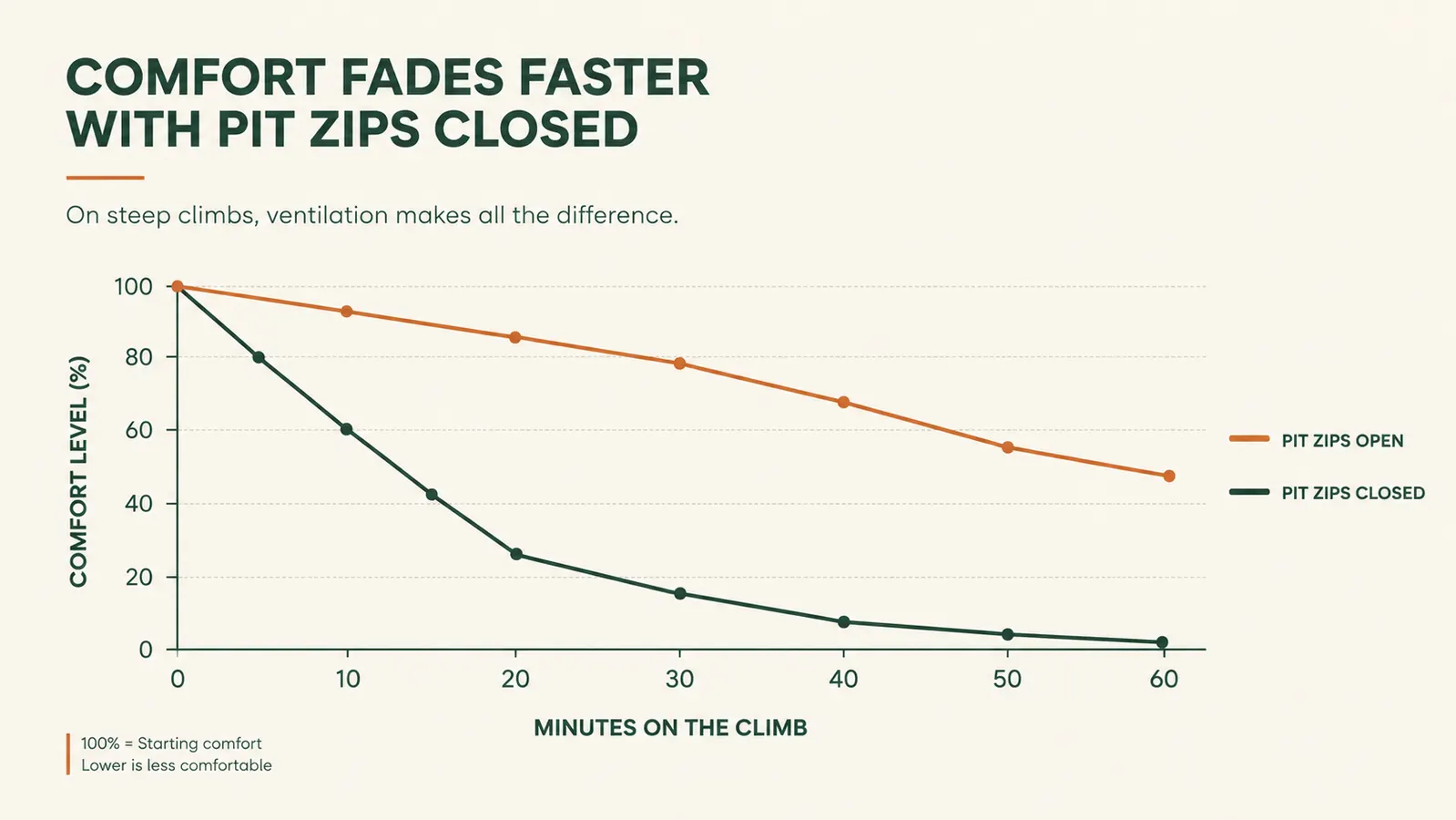
The honest number is more useful than the word. On a steady uphill in forty-five degree rain, I last about twenty minutes before the back of my shoulders feels damp in a way that is not rain. That is the marker of a real hardshell, not a failure. What the advertising does not tell you is that the pit zips are not optional furniture, they are the entire breathability system. Close them on a climb and you wear a sauna. Open them before the push and the jacket goes from stifling to acceptable.
My advice, learned the hard way, is to treat the zips as a reflex, open before every climb and closed at the top, and never expect the jacket to feel dry the way a softshell or a fleece does. If you are someone who hates babysitting zippers, that is a real mark against it, not a nitpick. It is the single biggest gap between the marketing and the morning, and the reason I tell people who run hot to keep reading all the way to who should skip this jacket. That honest answer often saves them the money.
The Fit You Should Actually Size For
The photos make the Marmot look like a trim running shell. It is not. It is cut boxy and long, and that is a feature once you understand it, but it is a surprise the first time you try it on. There is real room through the chest and shoulders for a midweight fleece, and the back hem drops lower than the front to keep your hips dry when you bend. Those are good things. They are also why the jacket looks a size big over a single tee, and why so many first-time buyers send it back before giving it a fair chance with a layer underneath.
Size it for what you will wear underneath, not for the mirror with nothing else on. If you mostly layer over a base layer and a light fleece, your normal size works and reads fine. If you buy a tighter size thinking it will look sleeker, you will lose the room that makes the jacket layerable, and you will feel the collar cinch on the climbs. When in doubt, size up and keep the pit zips. I would rather have a slightly roomy shell I can move in than a fitted one that fights me every time the temperature shifts, and I have owned both versions of that mistake.
One more fit note worth flagging. The sleeves run long, which sounds small but matters when you are reaching for a trekking pole or a boat cleat in the wet. Long sleeves are a deliberate hiking choice so your wrists stay covered when you stretch. But if you buy your usual size and already have long arms, the reach can feel almost too much. Again, it resolves itself when you buy for layering, but go into it knowing this is a jacket cut for motion, not for standing still in a showroom.
The Hood, the Cuffs, and the Little Compromises
The hood is where the Precip Eco makes its loudest personal choice. It is helmet-compatible, which sounds niche until you try to pull it over a ball cap on a rainy walk, at which point it reads as purpose-built. The downside is the same bigness. Over a bare head with no hat under it, the hood is roomy and a little flappy, and you will fiddle with the two cord locks more than you expect to get the field of view right. The brim is stiffened and does a real job of keeping rain off your face, which is worth the fiddling. I have stood in sideways coast rain and kept a dry forehead, which I cannot say about half the shells I have owned.
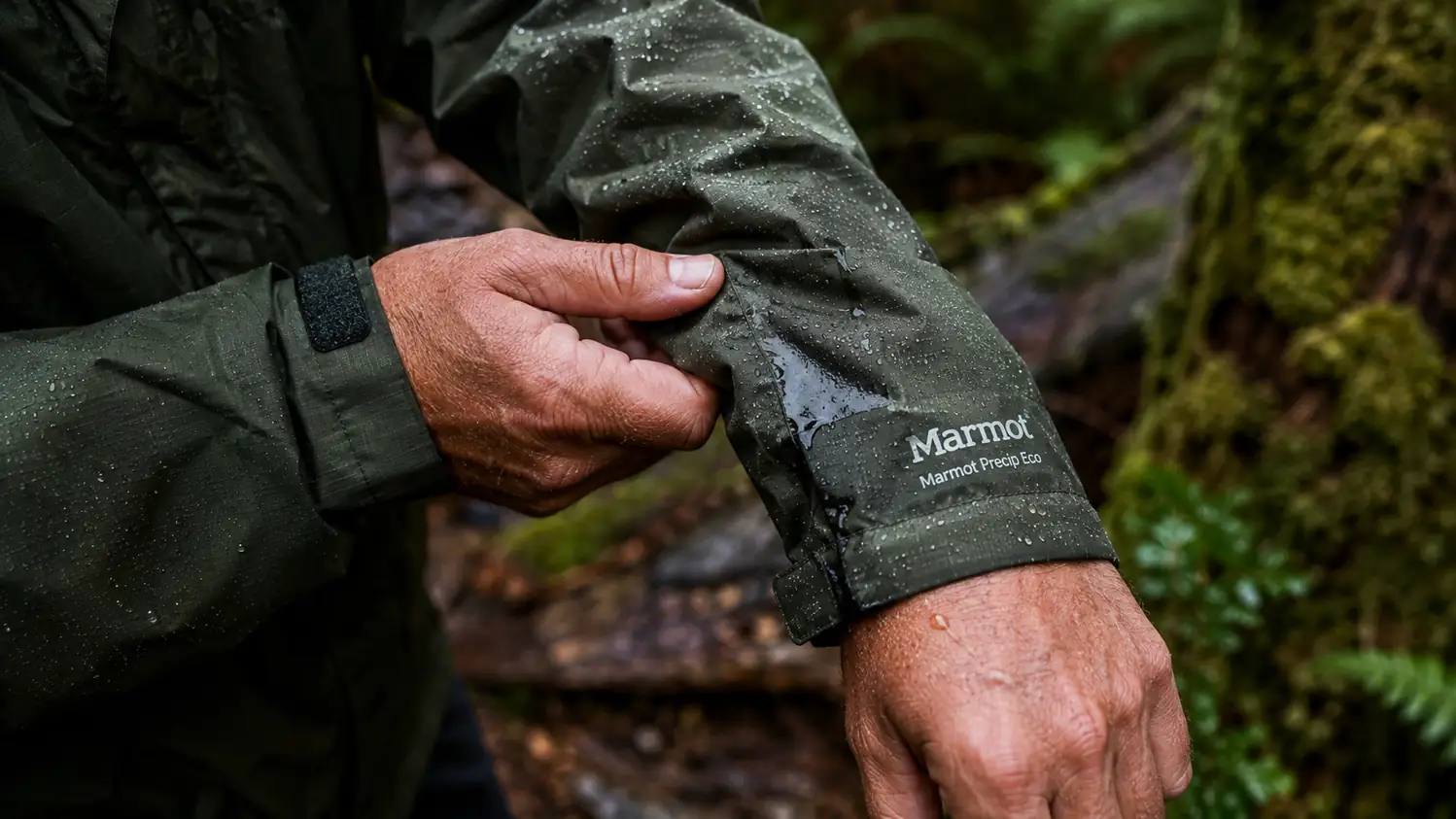
The cuffs close with one-handed hook-and-loop tabs, simple and effective, and the zippers are the two-way kind hidden under a storm flap. The hand pockets sit a touch high, fine for warming hands and burying a phone, less great for deep reach with gloves on. The chest pocket is small but welcome for a wallet or a snack you do not want to dig for. None of these are dealbreakers. They are the small, honest tradeoffs that marketing clips crop out, and I would rather flag them than have you discover them in the mud at a trailhead in the dark.
Here is the thing about the hood that nobody mentions in reviews that only spend one dry afternoon with the jacket. The storage collar, the little fold that tucks the hood away, is a two-handed job that takes a bit of wiggling to get right when the jacket is wet. It is not hard, and it is not a reason to avoid the Marmot, but it is exactly the kind of small reality that only shows up at minute forty on a drizzly day when your hands are cold. Factor it in and it will not surprise you.
Six weeks of steady Pacific Northwest rain is roughly where the factory DWR runs out of patience, and nobody warns you that a wash and a re-treat are part of owning it.
The DWR Is a Job, Not a Miracle
The thing that surprised me most was not the water getting in. It was the water eventually deciding to stay. The recycled face fabric of the Marmot Precip Eco comes with a durable water repellent coating, and for the first six weeks that coating did exactly what it was supposed to, rain beaded up and rolled off like the photos. Then it started to grey up and absorb, the shoulders wetting out into dark patches that made the jacket look drowned even while the membrane underneath stayed dry.
That is not a defect. It is physics, the coating wears down with friction, dirt, and grease from your neck and pack straps. But it is maintenance, and nobody in the ad copy mentions it. The fix is a specific wash with a tech wash, then a re-treat spray, and it takes an afternoon and a dry overnight. I do it once or twice a year now. If the idea of nursing a waterproof jacket annoys you, know it going in, because a re-treat-thirsty shell still breathes fine but stops beading and starts looking rough.
This is also where the honest review splits from the glowing one. The glowing reviews will tell you the waterproofing held up for years. The honest version is: it held up because I took care of it. Thirty minutes with the right cleaner and spray, twice a year, keeps the shoulders beading and the membrane doing its job. If you can live with that small seasonal chore, the protection on the Marmot is genuinely good, better than the budget shells I have compared it against. If you refuse to ever wash a jacket, you will blame the jacket when it is really the skipped maintenance talking.
Where It Honestly Beats the Budget Shells
I want to be fair to the other side, because the Marmot does not cost the same as a gas-station poncho, and the extra money has to buy something. It buys a quieter, softer fabric that does not sound like a bag of chips. It buys a cut with actual room for layers. It buys pit zips, a real hood with a stiffened brim, storm flaps, and hook-and-loop cuffs that outlast a season. And it buys a waterproofing layer that, with care, keeps working across years instead of failing on the first wet fall. I have owned the cheap stuff, and the difference is not subtle once the rain is real.
On the flip side, it is not the last word. It is a middleweight shell, heavier and less packable than an ultralight emergency poncho, and not in the same universe as a four-hundred-dollar alpine membrane for staying dry on a real summit blow. Understanding that it sits in the middle is the whole secret to liking it. It is the jacket for the person who does a bit of everything in ordinary PNW wet and wants one dependable layer, not the person who needs the extreme of either end.
I put the Precip Eco through a couple of comparisons this winter, side by side with a cheap packable that cost less than half as much and with a friend's heavier alpine shell. The cheap one wet out by the second mile and the sleeves were too tight to layer under. The alpine one kept me dry in a way the Precip could not, but it weighed more than twice as much and I would never carry it on a normal day. The Marmot sat between them, doing the job I actually needed on most days, and that is where its honest value lives.

Why the Price Sits Where It Does
You will see cheaper shells and you will see much pricier ones, and the Precip Eco sits in the middle for a reason that is more honest than heroic. The extra money over the budget rack buys the parts that actually matter across years, the two-way storm-flapped zippers, the stiffened brim hood, the fabric that does not shred the first time it meets a blackberry branch. It also buys a specific compromise, roomy enough to layer over a fleece, light enough to carry on the flat days, and consciously nowhere near as burly as an alpine storm shell costing several times as much.
What the price does not buy is magic, and this is where too many people talk themselves into disappointment. It still wets out at the DWR after a season and needs your attention. It still asks you to work the pit zips on the climbs. It will not keep you bone dry on a summit blow that is truly committed, no twelve-ounce hardshell will. I have come to think of it as a one-time insurance policy on a full season of ordinary Pacific Northwest wet, paid up front, then kept in force with the occasional wash and re-treat. If that framing sounds reasonable, the jacket will too. If it sounds like work, that is your honest answer before you buy.
There is also the question of whether the premium tier above it is worth chasing, and my honest answer after two winters is: for most people, no. The step up to a heavier alpine membrane buys real protection in a full storm, but it also buys weight and heat. The person who actually goes above treeline in bad weather should absolutely spend more. The generalist doing ordinary wet is not missing out by staying with the Marmot.
What I Liked
- Breathable enough to be a real improvement over budget packables
- Boxy, roomy cut that layers properly under a midweight fleece
- Stiffened brim hood keeps rain off your face
- Hook-and-loop cuffs and storm-flapped zippers hold up for years
- Waterproofing, with maintenance, keeps working season after season
Where It Falls Short
- Breathable is relative, you still manage your own heat with the pit zips
- Hood is oversized and flappy without a hat underneath
- Factory DWR wets out after a few weeks and needs a re-treat
- Boxy fit reads big over a single layer
- Lighter than budget shells, heavier than ultralight options
No twelve-ounce hardshell on earth will keep you bone dry on a truly committed summit blow, and pretending otherwise is how people end up disappointed in a good jacket.
Who This Is For
The Precip Eco is for the northwest generalist who does a little of everything in the wet, the Saturday hiker, the coast walker, the rainy camp cook, the person who needs one dependable hardshell and does not want to spend alpine-shell money for weather they will rarely push past. It is for the buyer who is willing to learn two habits, opening the pit zips on the climbs and giving the DWR an occasional afternoon of care. For that person, the honest tradeoffs are a fair price to pay, and the jacket will quietly become the most-worn piece of gear in the closet.
It is also for the person who wants the peace of mind of a real brand behind it. Marmot has been making this exact jacket for years, and there is something to be said for a shell that is essentially unchanged because the design works and the sizing is predictable. When I recommend it, I recommend it as a buy-one-and-be-done-for-a-season piece. That reliability is part of what you are paying for, and it is the part that pays you back every time you grab it off the hook on a gray morning.
Who Should Skip It
Pass on it if you spend serious time above treeline in year-round weather, where you want a burlier membrane and are ready to pay for it. Skip it if you run hot, hate managing zippers, and would rather have a more breathable softshell and just accept getting wet. And skip it if you only need a backup layer to keep in the car, because for that you can go lighter and cheaper without the maintenance. Buy the Precip Eco for real but ordinary Pacific Northwest wet, and buy it with your eyes open about everything above.
The honest bottom line is that this is not the jacket for everyone, and pretending it is would be the dishonest part of a dishonest review. It is a middleweight hardshell with real limits, and I have told you exactly where they are. If you are the person who hovers in that middle, who does most of your outdoor life in the ordinary drizzle and gray that defines this corner of the country, it earns its keep every week. If that is not you, I have saved you the money and the disappointment, which is the other half of an honest review's job.
Now you know the real it. See what it costs today and decide with both eyes open.
The Precip Eco earns its place for the right kind of wet, and the caveats are the ones in this review. Check today's price on Amazon and grab the sizes before the season fills up.
Amazon Check Today's Price on Amazon →